
The customer is always right, right? As the end-point of your business – the consumer of your finished product or service – the answer by default has to be a resounding yes, doesn’t it? As obvious as it sounds, it’s worth spending a few minutes to take stock and think about how your business functions. Every process it undertakes to provide that product or service needs to be optimised to give your customer what they want. And what they want, as has been proven time and time again, are good products and services from happy employees who take pride in working for your company. And why do they want this? Because happier employees are more motivated to make better things and offer better services.
This is the concept of the customer-centric approach, and it’s an idea that’s been growing in popularity over the past 30 years as other approaches have fallen by the wayside. An article in the Houston Chronicle gives the example of Michigan State University (MSU), which has an Organizational Success statement to help staff members respond more effectively to customers. The statement “includes performance targets such as effectively responding to the concerns and needs of customers in a timely and accurate manner” and aims “to minimize the procedures required to meet customer needs”. An example of this, the article suggests, is to streamline internal procedures (and reduce bureaucracy) so as to better serve a customer problem.
MSU is not alone. Berlitz Language Schools, Disney and Southwest Airlines are other examples of companies that have adopted “Total Customer Orientation”, according to customerservicemanager.com. But despite such widespread acceptance, it’s not the only method a business can choose in which to operate. Another popular strategy is that of the sales-oriented approach, which fixes the needs and wants of the firm or the salesperson as the guiding principle on which things are done. The operations-based business, on the other hand, makes all of its decisions from a process point of view.
At any rate, the customer-first approach is here to stay. In the social-media age, when everyone from employee to consumer has the power to influence others via friendship groups and social networks, it pays to keep people happy at whatever point they experience your company because the trickle-down effect will always stop at the person buying your product or service. One way to ensure happy customers is to ensure happy workers, and a big part of that involves flexible working practices. By their nature, they minimise bureaucracy and time-consuming, non-customer-serving activities in a number of different ways.
The empowering act of allowing your employees to work flexitime is a hugely motivating factor. Being there at the school gates or having the option to drop in on an elderly neighbour in the middle of the day is what the work/life balance is all about, and it’s a huge incentive for the millennial generation (who also happen to be the largest group in the workforce). Studies have shown that when we make our own decisions about how and when we work, productivity increases – one piece of research by the Harvard Business Review found a 4.4% uptick in output. And the growth in cloud computing and super-fast Wi-Fi supports the flexibility we crave.
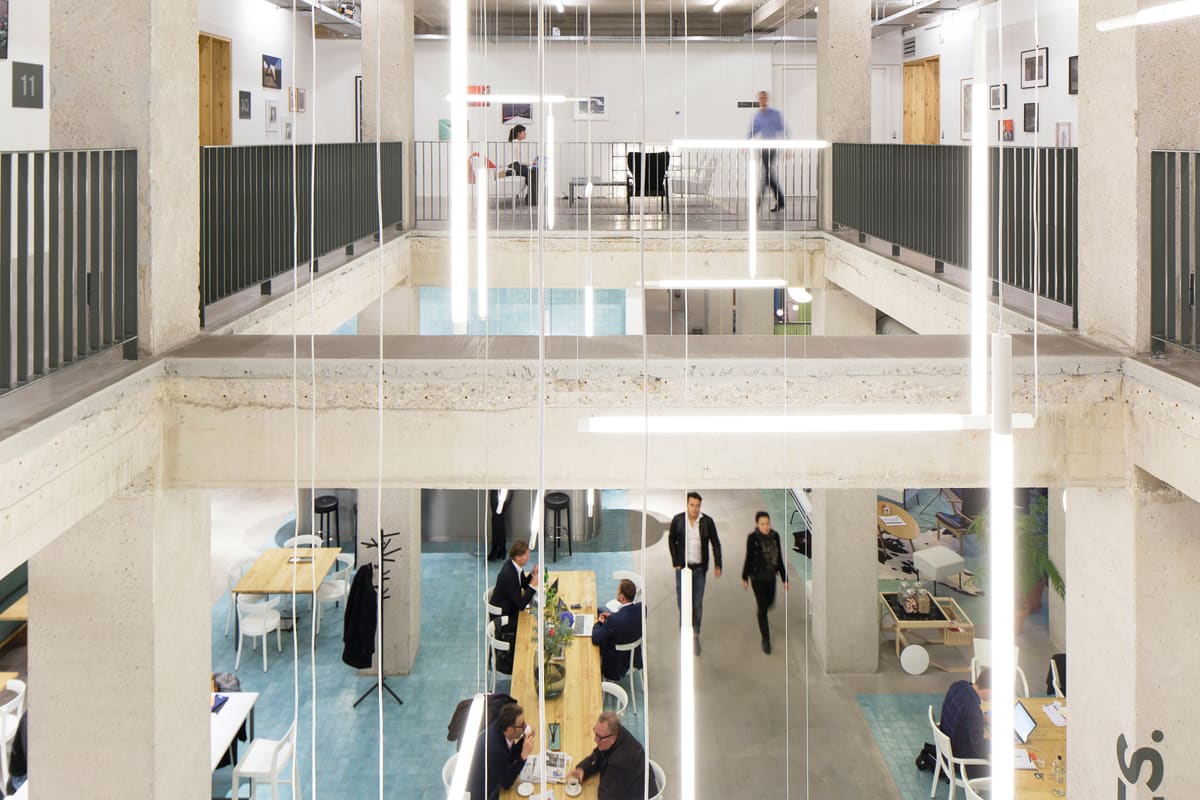
As we rethink the how and when we work, it follows that we should rethink the where too. And this is where the flexible office (also known as flexspace) comes in. A flexible work environment can mean much more than the kitchen table, especially when you consider that humans are social animals and that businesses still need to convene on occasion. The cloud-based software company Salesforce found that, when work projects fail, 86% of employees and managers blamed poor workplace structures including a lack of collaboration and communication (pack animals that we are, it’s unsurprising if people who regularly go to an old-fashioned office stick to their silos instead of mingling with others they don’t know).
Coworking and flexspace can help to put the customer first in another, more direct, way too. Businesses often find that proximity plays a big part in keeping the customer happy, and a flexible-office provider with a large network allows a business to scale in a way that’s not only efficient but also cost-effective. With this option, a business can offer its services nationwide without any of the hassles that come with investing in bricks and mortar: simply turn up at your chosen new destination and start serving your clients from the comfort of a professional environment that’s a pleasure to be in.
Putting the customer first means taking a 360-degree view of every aspect of your business. From employee job satisfaction to the buildings you occupy, nothing is off-limits and every little counts. As the customer-first approach has grown in popularity, perhaps it should come as no surprise that the rise of flexspace has grown with it.
Find out how IWG can help your business to achieve a customer-first approach