
Landlords can help tenants meet their sustainability goals by diversifying their portfolio to include flexspace.
With 2021’s COP26 climate summit underway, it’s an important reminder that office occupiers, as with all companies, are going to be prioritising the need to address their environmental, social and governance (ESG) responsibilities in the coming years.
From a boardroom perspective, climate change is one of the key challenges that will dominate public policy in the coming decade, and businesses will face increasing pressure from stakeholders to formulate their ESG goals and demonstrate progress towards achieving them.
Commercial real estate will have a key part to play in that – not just because it represents a large proportion of a company’s carbon impact, but also because the growing trend towards flexible workspace facilitates a more sustainable style of working.
While companies will define their own ESG goals in the context of their business sector and operating environment, the World Economic Forum has established a set of common metrics for consistent reporting of ‘sustainable value creation’ that identifies some 22 different measures for companies to score themselves on.
These range from greenhouse gas emissions, community investment and employees’ health and wellbeing, to water consumption, impact on nature loss and levels of workplace training – any and all of which could be included in ESG targets.
Lower energy bills
For landlords, partnering with a flexspace operator is going to make even more sense over the coming years, because hybrid working can help companies to meet their ESG goals in several ways.
First of all, it can reduce the physical space a corporate tenant occupies – and, consequently, lower their carbon footprint. In a traditional office environment everyone has their own desk but many are unoccupied at any one time. In a flexible office, desks are shared so you need far fewer, especially if your people are working from home or a central HQ for part of the week.
That’s significant, since buildings account for 39% of CO2 emissions globally and, apart from the carbon embedded in construction, office buildings are significant consumers of energy for both heating and air-conditioning.
Owners who offer their buildings on a flexible basis are making more efficient use of their physical assets and offering the occupier an opportunity to improve their energy performance. For example, IWG has committed to an ongoing improvement in the sustainable consumption of water and energy in its buildings, achieving year-on-year energy and carbon reductions that are submitted to the Carbon Disclosure Programme – in 2020, its gas and electricity costs per workstation were 33% lower than the baseline in 2016.
Improved wellbeing
As part of a hybrid working strategy, flexible workspace can also play a part in reducing commuting. In fact, according to a 2019 Regus Economic Survey, allowing people to work closer to home saves an average of 7,416 commuting hours per centre per year, equating to 118 metric tonnes of carbon.
Travelling less is another positive in ESG terms – not just in lowering the carbon impact caused by travel but through improving work-life balance, because people don’t have to spend hours a day in their car or on a train.
More than half of commuters say the commute increases their stress levels, with many reporting a reduction in sleep or physical activity as a result, according to the Health in a Hurry report by the UK’s Royal Society for Public Health.
When a company adopts hybrid working, it can contribute towards achieving better gender balance and diversity, too. Working from home some of the week, both male and female workers can share caring roles more evenly, and there are better opportunities for those who are more remotely located or are challenged to work five days a week in the office to participate in the workforce.
Higher standards
The buildings with most to offer companies in terms of meeting their ESG targets will be those that have good environmental and energy certifications. Those that are highly rated under the BREEAM (Building Research Establishment’s Environmental Assessment Method) or LEED (Leadership in Energy and Environmental Design) schemes are ripe for investment as both reward buildings that use less energy in their construction and operation, reduce waste, conserve water and incorporate sustainable materials.
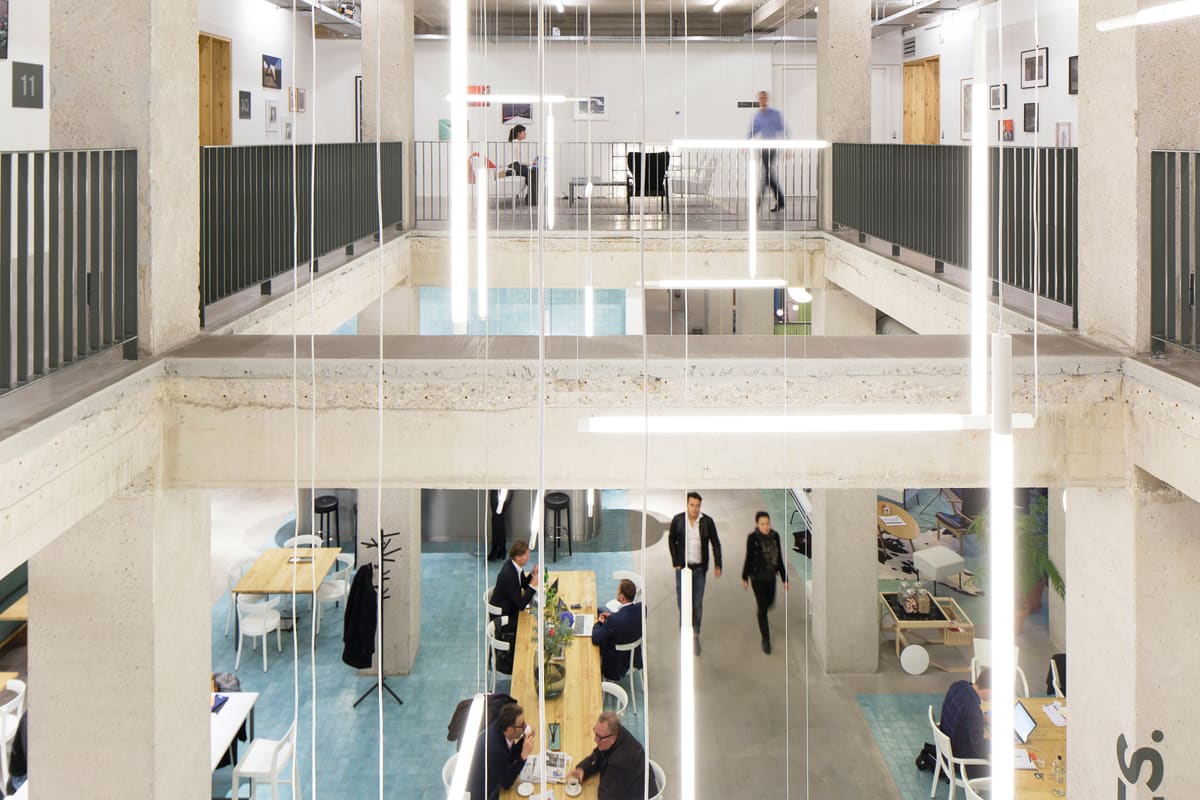
A number of IWG locations including Spaces’ Tour & Taxis location in Brussels, for example, is set within the BREEAM Outstanding-rated Gare Maritime, which achieves carbon neutrality through geothermal and solar power. What’s more, rainwater is harvested to irrigate its ten on-site gardens.
For landlords, the challenge is to upgrade existing stock and focus new investment on high performance buildings. By offering flexible workspace, they will be turbo-charging the ESG benefits for their commercial tenants.
Find out more about how hybrid working can support a number of the United Nations’ Sustainable Development Goals for 2030 in our white paper ‘Hybrid World: Sustainable World’.
Flexible workspace is the fastest-growing sector of the global workplace market. Make the most of this exciting investment opportunity by partnering with IWG today.